
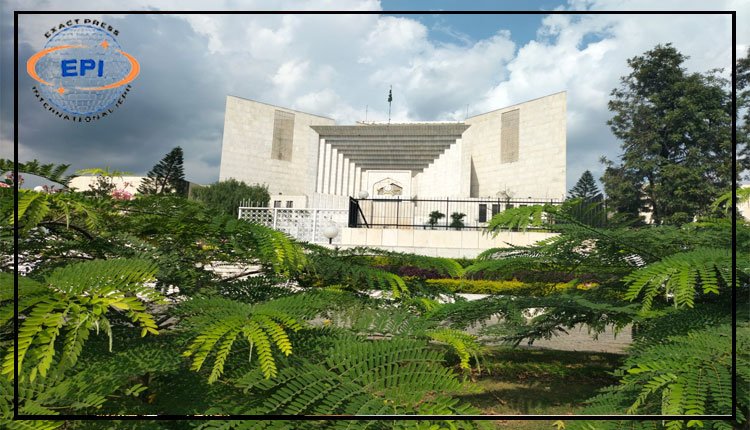









Supreme Court of Pakistan moves towards Digital Justice
ISLAMABAD, April 22 (EPI): Supreme Court of Pakistan (SCP) on Wednesday has stated that apex court has taken steps towards Digital Justice system.
according to a statement issued by spokesperson of SCP Shahid Hussian Kamboyo, in a decisive step towards a more transparent, accessible, and citizen-centric justice system, the Supreme Court of Pakistan has successfully integrated cutting-edge technology into its judicial processes, redefining how justice is delivered across the country.
Harnessing digital innovation, the Court has operationalized seamless multi-location hearings – bringing together benches, counsel, and litigants from across Pakistan without geographical constraints. In a recent landmark hearing, the Bench convened at the Principal Seat in Islamabad while counsel joined simultaneously from Quetta, Hyderabad, and Karachi, ensuring uninterrupted proceedings and equal participation. Demonstrating institutional agility, the Court swiftly adapted to an emergent change in bench composition earlier this week.
The Chief Justice of Pakistan presided over proceedings from Islamabad, while Justice Ayesha A. Malik joined the Bench from Lahore – ensuring seamless continuity without any compromise on judicial efficiency. Further reinforcing this transformation, today’s entire docket was heard with the Bench sitting in Islamabad while counsel and parties appeared from Quetta, showcasing a fully functional, technology-enabled judicial ecosystem.
These proceedings are particularly significant as they mark a decisive shift away from the conventional reliance on physical paper books. Instead, fully digitized case files were utilized during hearings, eliminating the need to retrieve records from Branch Registries and substantially enhancing efficiency, speed, and transparency.
The Supreme Court’s reform initiatives reflect both scale and substance: case files have been digitized to ensure secure and efficient record management; cases barcoded for precise tracking and transparency; digital case filing introduced to reduce procedural delays and enhance accessibility; electronic transmission of court orders enabling swift delivery of decisions; digital payment systems operationalized to simplify processes for litigants; video-link hearings institutionalized to bridge distances and reduce costs; and an e-office system introduced as an integral component of the broader digitization ecosystem.
These reforms mark a paradigm shift from conventional courtroom practices to a dynamic, technology-driven model that prioritizes accessibility, efficiency, and transparency. By eliminating logistical constraints and enabling real-time participation from multiple locations, the Court is making justice more inclusive and responsive to the needs of citizens.
Ends-Abid Ali Arain